
Article
PR Notice 98-10 replacement: what changes for pesticide label edits
EPA's draft PR Notice 2026-NEW would replace PRN 98-10. What it changes for label notifications, non-notifications and bilingual text, and what to do now.
· 3 min read
Want to learn more?
See how teams in regulated categories cut review time by 60–80%.
Book a live demoWatch walkthroughOn January 5, 2026, EPA published a draft Pesticide Registration Notice that, when final, will supersede PR Notice 98-10, the 1998 guidance registrants have used for almost 30 years to decide whether a label change needs EPA review. Comments closed on March 23, 2026 after an extension.
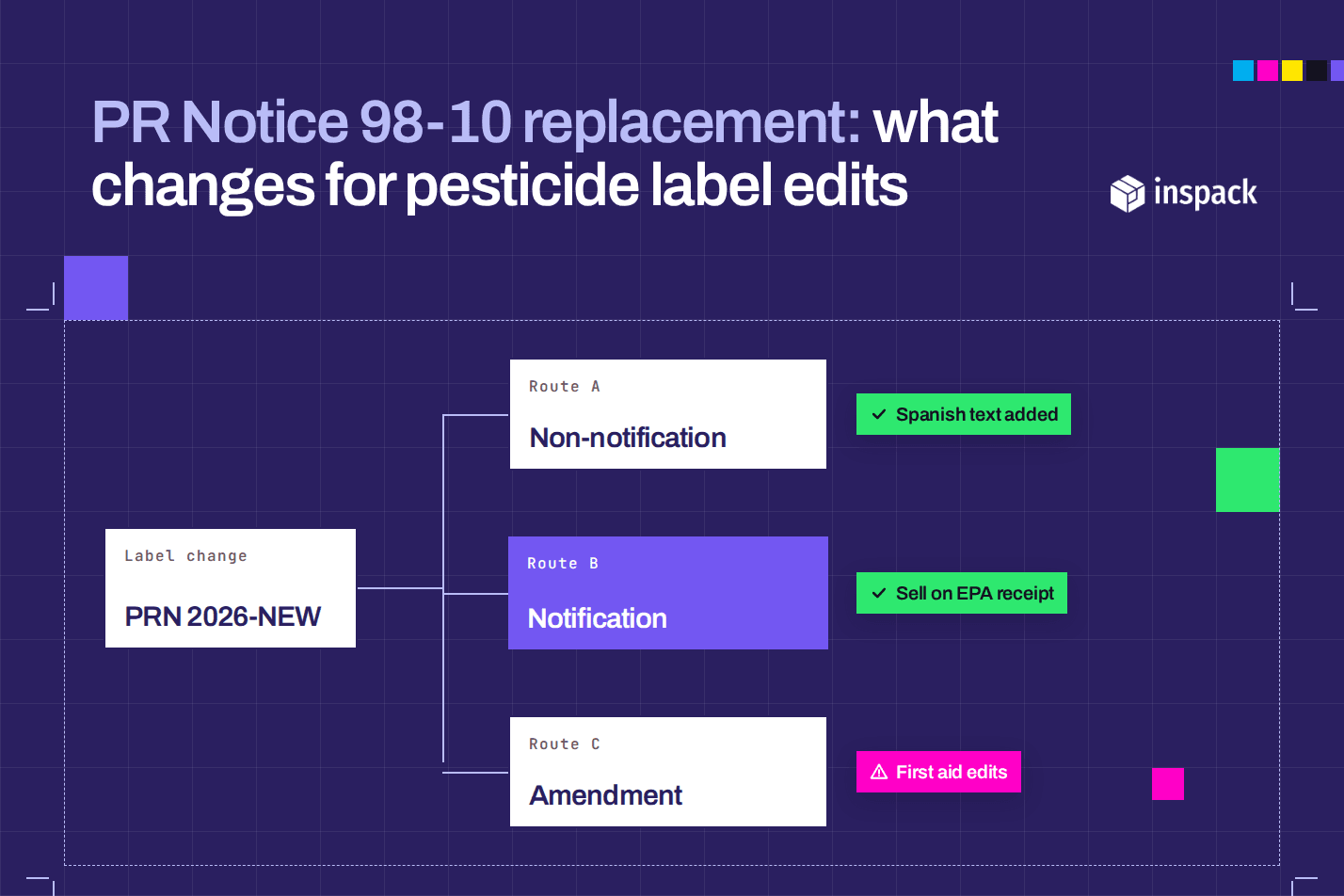
The draft, called PR Notice 2026-NEW, updates which pesticide label changes can be made by notification, by non-notification or only by amendment. It would let products modified by notification be sold as soon as EPA receives the notification, move bilingual labeling into non-notification, and send some first aid and disposal edits back to amendment. At the time of writing (November 2026), we could not find a final version.
What is PR Notice 98-10?
PR Notice 98-10 explains which changes to a registered pesticide's label or formulation can be made without a full amendment. It sorts changes into three routes:
- Notification: the registrant tells EPA about the change under 40 CFR 152.46, without waiting for a full review.
- Non-notification: very limited changes that need neither notice nor approval.
- Minor formulation amendment: small formulation changes with an expedited review.
Anything outside those routes needs a full EPA label amendment, which takes longer and carries a PRIA fee.
What would change for EPA label notifications and amendments under PR Notice 2026-NEW?
EPA published a 14-page summary table of significant changes in the docket. The changes most relevant to label teams:
Area | Draft PR Notice 2026-NEW |
|---|---|
Selling after a notification | All products modified by notification could be sold or distributed once EPA receives the notification |
Bilingual labeling | Adding Spanish translations through non-notification, if consistent with EPA's regulations |
Inert ingredients | Optional listing of all inert ingredients on the label through notification |
Symbols and graphics | Placeholders for many symbols and graphics on master labels through notification; symbols that denote a certification still need an amendment |
First aid and disposal statements | Some changes previously allowed by non-notification, such as non-pesticidal changes to first aid statements, would need an amendment |
Label referral statements | Changes to statements that direct users to another section of the labeling |
Supplemental distributor labels | A new description of how non-notification changes should carry over to supplemental distributor labels |
Older guidance | Deletes sections already replaced by other PR Notices, and replaces contrary guidance in section II of PR Notice 2000-5 |
Sources for the table: Bergeson & Campbell, Beveridge & Diamond and the Federal Register notice.
Is PR Notice 2026-NEW binding?
No. Like PR Notice 98-10, it is guidance. The Federal Register notice says the final notice would not be binding on EPA or registrants, and EPA can still take action if a product was changed by notification when it should have gone through an amendment. Until EPA issues the final notice, PR Notice 98-10 remains the guidance in effect.
What should pesticide label teams do now?
- Keep using PR Notice 98-10 for changes you make today, and record which route you used for each change.
- Flag planned changes the draft would move, especially first aid and disposal edits, so you are not caught mid-project when the final notice arrives.
- Plan bilingual updates with the non-notification route in mind; see our guide to EPA digital pesticide labels for the Spanish translation options.
- Review supplemental distributor labels so they pick up every non-notification change made to the main label.
- Watch docket EPA-HQ-OPP-2025-2863 for the final notice; EPA has said the final notice takes effect immediately.
How Inspack helps with pesticide label changes
Inspack compares label versions and checks pesticide artwork against EPA and FIFRA requirements, so you can see every difference between a marketed label and its master label before you decide whether a change needs a notification, a non-notification record or an amendment. Learn more on our regulatory compliance page, or read how Catchmaster reviews its EPA-regulated labels.
This article is general information, not legal or regulatory advice.
See exactly what changed between label versions before you file.
Inspack compares your marketed label with the master label and checks it against EPA rules.
Frequently asked questions
Has EPA finalized the replacement for PR Notice 98-10?
At the time of writing (November 2026), we could not find a final version. EPA published the draft on January 5, 2026 and closed comments on March 23, 2026. Check EPA's PR Notices page and docket EPA-HQ-OPP-2025-2863 for updates.
What is the difference between an EPA label notification, a non-notification and an amendment?
A notification means telling EPA about a label or formulation change under 40 CFR 152.46 without waiting for a full review. A non-notification is a very limited change that needs no notice and no approval. Anything outside these routes needs an amendment.
Can I add Spanish translations without EPA review?
Yes. Under PR Notice 2025-02, adding the Spanish translation from EPA's Spanish Translation Guide is a non-notification change, reported in MyPeST. The draft PR Notice 2026-NEW keeps bilingual labeling in the non-notification route.
Do supplemental distributor labels need updating after a non-notification change?
The draft adds a description of EPA's expectations for carrying non-notification changes over to supplemental distributor labels. Review those labels whenever the main label changes.